
What is established about Titanic today
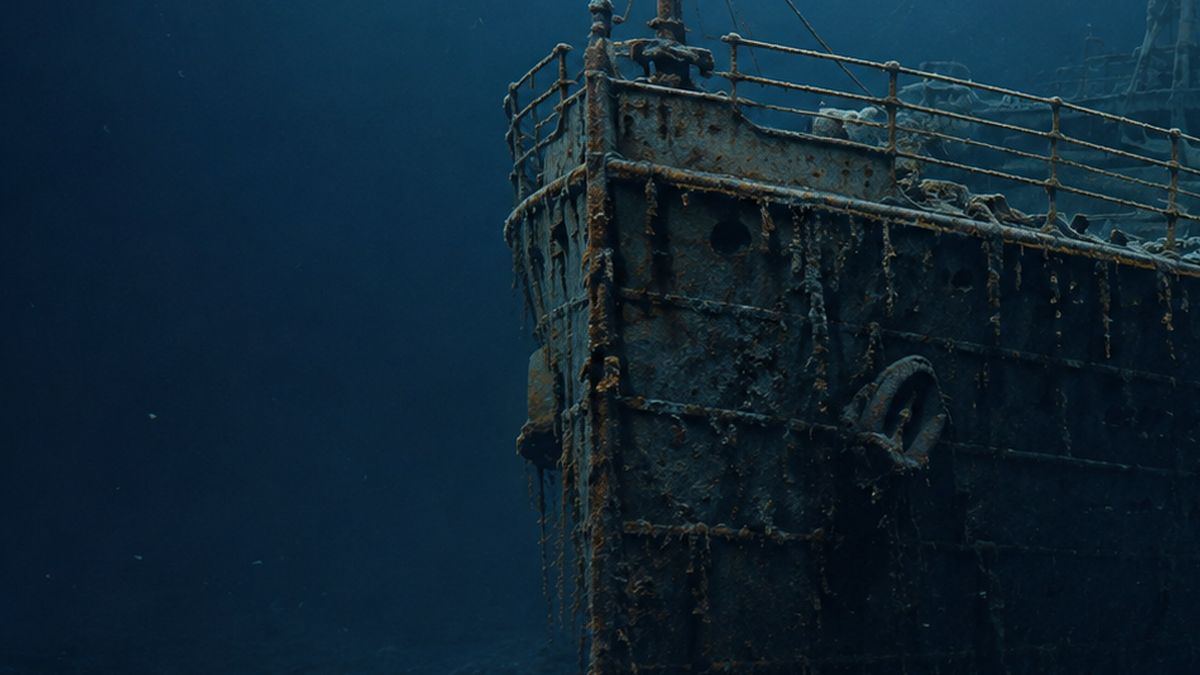
- The bow is still recognizable, but it has suffered visible collapses and lost part of its forward railing by 2024.
- The stern is much more damaged because it flooded and descended violently after the breakup.
- The Grand Staircase’s wooden structure is gone; the open shaft and nearby steel features remain useful reference points.
- Rusticles are living microbial communities associated with the breakdown of the wreck’s iron.
- No exact disappearance date is known. Titanic will change unevenly, with some sections and materials lasting longer than others.
- The wreck is both an archaeological site and a maritime memorial, creating tension between recovery, research and leaving objects in place.
What remains in each part of the wreck
| Area | Condition today | Why it looks that way |
|---|---|---|
| Bow | Recognizable hull shape, anchors, deck machinery and bridge-area remains; increasing local collapse. | It descended more cleanly and buried its forward end in sediment. |
| Stern | Crushed, twisted and difficult to match to the original deck plan. | It flooded through the break, rotated and struck the seabed with enormous force. |
| Debris field | Thousands of structural pieces, fittings and personal objects spread across a wide area. | The breakup, descent and impacts released material from the ship’s interiors. |
| Grand Staircase area | Open shaft and surrounding steelwork rather than the famous wooden staircase. | Wood was destroyed, detached or consumed, while stronger structural elements lasted longer. |
Condition descriptions are broad. The wreck changes over time and no short table can represent every room or object.
What the bow looks like today
The bow is the image most people recognize. Its forward profile, anchors, capstans and deck shape still resemble a ship. The bow cut through the water during descent and entered the seabed at an angle, which helped preserve its overall form compared with the stern.
Recognizable does not mean intact. The mast fell, the bridge has deteriorated, officers’ quarters and deck structures have opened, and large areas have weakened. The 2024 RMS Titanic, Inc. expedition documented that a roughly 15-foot section of the port-side forward railing had fallen since earlier surveys. The iconic outline seen in old photographs is therefore changing in visible ways.
The forward tip and keel area are buried in sediment. This protects some material while making other questions, including the exact appearance of the iceberg damage, difficult to answer through direct viewing.
Why the stern is so badly damaged
The stern’s condition begins with the breakup. Once the ship fractured, the aft section remained partly afloat for a short time, then flooded through a huge open end. Water rushed through rooms and decks while trapped air escaped. The stern rotated and descended in a far less stable way than the bow.
On impact, decks collapsed and machinery shifted. The result is a compressed, twisted mass rather than a clean ship shape. Large engines and heavy equipment remain identifiable, but many passenger spaces are difficult to locate without detailed mapping and comparison to plans.
The difference between bow and stern is one of the clearest physical lessons from the wreck. Titanic did not sink as one rigid object. Each section had a separate descent and a separate impact history.
The debris field and the objects between the sections
The area between and around the bow and stern contains boilers, coal, hull pieces, dishes, shoes, luggage, fixtures and thousands of other objects. Some came from the break itself. Others fell from open rooms as the sections descended or broke loose on impact.
The debris field matters scientifically because the position and type of objects help researchers reconstruct how the ship broke and descended. It matters emotionally because personal belongings make the site more than a large piece of steel. A cup, suitcase fitting or pair of shoes can point back toward a passenger or crew life even when no name is attached.
Recovery debates often focus here. RMS Titanic, Inc., the court-recognized salvor-in-possession, has recovered thousands of artifacts from the debris field, while the major hull sections have generally been left in place. The company does not own the entire wreck outright, and its rights are shaped by court orders, preservation rules and international agreements.
What happened to the Grand Staircase
The Grand Staircase was largely made of wood, glass and decorative materials supported within the ship’s steel structure. The famous staircase itself is no longer standing. In its place is an open shaft visible in exploration footage, with surrounding decks and structural features providing clues to the original location.
It is not possible to say that the entire staircase simply floated out in one perfect piece. The sinking, breakup, pressure changes, impact, currents and decades of biological decay all acted on it. Some wooden material may have broken free during the descent, while the rest deteriorated after the wreck reached the bottom.
Nearby spaces have also changed. Cabins lost walls, decks sagged, and exposed interiors became more open over time. Comparing early footage with later surveys allows researchers to document those changes rather than relying on a single frozen image.
Rusticles, bacteria and structural deterioration
Rusticles look like hanging icicles made of rust, but they are complex microbial communities. They live on the wreck and are associated with the movement and breakdown of iron. NOAA uses Titanic as a scientific laboratory for understanding how metal shipwrecks change in deep water.
Microbes are only part of the process. The ship was already violently damaged before it reached the bottom. Salt water, corrosion, currents, sediment movement, gravity and the weight of collapsing decks all contribute. Human visits may also affect a fragile site through contact, dropped material or thruster wash, which is one reason careful operating rules matter.
Different materials behave differently. Cast-iron boilers remain relatively strong. Thin steel, railings and unsupported decks may fail sooner. Glass, ceramics and some metals can remain recognizable while wood, fabric and paper disappear or require special conditions to survive.
Will Titanic completely disappear?
Titanic will continue to deteriorate, but claims that it will vanish entirely by one exact year are too certain. A wreck this large does not disappear like a melting ice cube. Railings may fall, decks may collapse, and recognizable rooms may be lost while boilers, engines, anchors and thick structural pieces remain much longer.
Predictions depend on what a person means by disappear. The ship could lose its familiar outline while still leaving large amounts of metal and a vast archaeological field. Sediment may bury some material as exposed sections weaken. Future mapping will probably show a long transition rather than a single end date.
The careful answer is that the recognizable wreck is changing now, its rate is uneven, and continued documentation is important. No source can responsibly promise the year of its total disappearance.
How modern mapping records the wreck
Early expeditions relied on video, still photographs and hand-built maps. Modern surveys add multibeam sonar, photogrammetry, LiDAR, magnetic sensors and millions of overlapping images. Software can combine those records into detailed three-dimensional models of the bow, stern and debris field.
A digital model does not replace the physical site, but it allows researchers to measure change. Images from one year can be compared with earlier data to identify a missing railing, a new collapse or movement of debris. It also lets historians examine relationships between objects without disturbing them.
The 2024 expedition used ROVs and advanced imaging to compare the wreck with earlier surveys. Its more than two million images are still a dated record, not a permanent final view. The wreck will continue to change after every expedition leaves.
Latest documented wreck expedition in this guide: 2024
The most recent wreck-condition expedition described in the sources reviewed for this page took place in 2024 and was operated by RMS Titanic, Inc. The team used two remotely operated vehicles along with sonar, LiDAR and magnetic sensing. It captured more than two million high-resolution images and worked to compare current conditions with earlier mapping.
The best-known structural finding was the loss of part of the port-side bow railing. The expedition also relocated and photographed the Diana of Versailles, a bronze statuette from the First Class Lounge that lies in the debris field. These discoveries show both sides of wreck research: documenting loss from the ship and finding objects that had not been seen clearly for decades.
Latest wreck-condition expedition described in the sources reviewed for this page as of August 2026.
Artifact recovery versus leaving the wreck in place
There are two serious preservation arguments. One view favors keeping the site and its objects in place whenever possible, because archaeological context is lost when an item is moved and because Titanic is a memorial associated with mass loss of life. International guidance treats in-place preservation as the preferred starting point.
The other view argues that carefully recovered debris-field objects can be conserved, studied and shown to the public before corrosion destroys them. Recovered artifacts have taught people about construction, daily life and individual passengers, but they require expensive long-term conservation after removal from salt water.
A responsible page should not pretend this debate has one easy answer. The major hull sections, human remains and personal objects raise different questions. Law, archaeology, memorial ethics, science and public education all meet at the wreck.
Why the wreck is treated as a maritime memorial
More than 1,500 people died in the disaster, and many were never recovered. The wreck and surrounding seabed are therefore linked to their final resting place. NOAA describes Titanic as both a maritime memorial and a scientific laboratory, two roles that should remain connected rather than separated.
The United Kingdom and United States brought a protection agreement into force in 2020, emphasizing respectful treatment and coordinated oversight. Plaques left by expeditions, including memorials to researchers, show how the site has accumulated its own later history as well.
The best way to understand Titanic today is to hold several truths together. It is a deteriorating ship, an archaeological site, a deep-sea ecosystem, a place of scientific work, and a memorial to individual passengers and crew.
Sources for the wreck’s present condition
Date-sensitive claims are labeled by expedition year so later discoveries can be added without rewriting the historical record.
- NOAA Ocean Today: The Titanic Wrecksite Rusticles, deterioration, Captain Smith’s cabin and the wreck as memorial and scientific laboratory.
- NOAA: RMS Titanic history and significance Historical significance, location and federal preservation context.
- RMS Titanic, Inc.: 2024 expedition results 2024 imaging, bow-railing loss and rediscovery of the Diana of Versailles.
- RMS Titanic, Inc.: Titanic wreck site Current descriptions of the bow, stern, debris field, marine life and recent documented changes.
- UK Government: RMS Titanic wreck protection treaty International protection and memorial treatment.
- TitanicSurvivors.com sources guide How the site handles changing evidence and conflicting historical claims.
Continue through wreck, interiors and memory
Frequently asked questions
Where is the Titanic wreck?
The wreck lies in the North Atlantic southeast of Newfoundland, with the bow near 41°43′57″N, 49°56′49″W.
How deep is the Titanic wreck?
About 12,500 feet or 3,800 metres below the surface.
Is Titanic still recognizable today?
Yes, especially the bow, but collapses and corrosion are steadily changing its familiar outline.
Is the Grand Staircase still inside the wreck?
No. The famous wooden staircase is gone, though its open shaft and surrounding structural area remain identifiable.
What are rusticles?
They are icicle-like microbial communities on the wreck that are associated with the breakdown of iron.
When will Titanic disappear?
There is no reliable exact year. Different parts will collapse or survive at different rates.
Who owns Titanic?
No company simply owns the whole wreck. RMS Titanic, Inc. is salvor-in-possession with court-recognized recovery rights that operate under legal and preservation limits.
What was found in the 2024 expedition?
The expedition documented a missing section of bow railing, captured more than two million images, and relocated the Diana of Versailles statuette.