
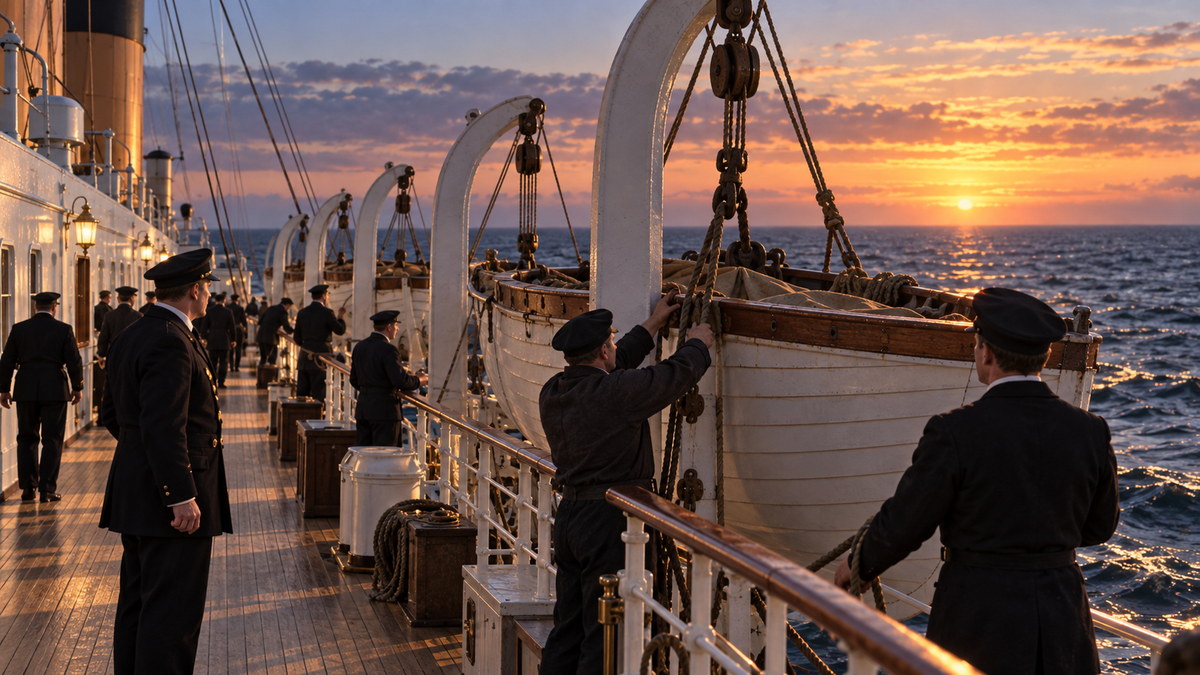
Titanic lifeboats in brief
- Titanic carried 20 boats: 14 standard wooden lifeboats, two emergency cutters and four collapsibles.
- Their combined rated capacity was 1,178 people, compared with about 2,208 aboard.
- Titanic exceeded the British legal requirement, which was equivalent to about 962 people, but the rule itself was outdated.
- The American inquiry said Titanic’s 16 sets of double-acting davits could handle as many as 48 boats. Alexander Carlisle also testified that he personally favoured 48.
- A 64-boat scheme was discussed during design testimony, but Carlisle explicitly did not say Titanic ought to have carried 64.
- Hundreds of rated places went unused in the evacuation, especially in several early boats, but an exact unused-seat total depends on the reconstruction used.
Titanic lifeboat capacity at a glance
The British inquiry recorded 20 boats and a combined rated capacity of 1,178 people.
| Boat type | Number carried | Rated capacity each | Combined capacity |
|---|---|---|---|
| Standard wooden lifeboats | 14 | 65 people | 910 people |
| Emergency cutters | 2 | 40 people | 80 people |
| Engelhardt collapsibles | 4 | 47 people | 188 people |
| Total | 20 | Not applicable | 1,178 people |
About 2,208 passengers and crew were aboard, so even perfectly filled boats would have left a shortfall of roughly 1,030 places.
How many lifeboats were on the Titanic?
Titanic carried 20 lifeboats. Fourteen were standard wooden lifeboats rated for 65 people each. Two smaller emergency cutters were rated for 40 each. Four Engelhardt collapsible boats were rated for 47 each. The British inquiry therefore gave the total rated accommodation as 1,178 people.
The odd-numbered boats were on the starboard side and the even-numbered boats on the port side. Collapsibles C and D were stored on the Boat Deck, while A and B were stored on the roof of the officers’ quarters. A and B were still being worked on during the final minutes and were swept into the water rather than lowered normally.
What was the Titanic lifeboat launch order?
Boat 7 is generally treated as the first boat lowered, at about 12:45 a.m. The final boat lowered normally was Collapsible D at about 2:05 a.m. Collapsibles A and B entered the water during the final plunge rather than through a normal davit launch.
Exact launch times remain one of the difficult parts of Titanic reconstruction. The British inquiry printed one sequence but warned that times after the collision were unreliable. Later researchers have revised several times by comparing witness testimony, deck positions and overlapping events. The searchable directory above therefore uses approximate times and ranges rather than pretending every minute is settled.
Why could Titanic’s lifeboats hold only 1,178 people?
Titanic complied with the British rules then in force and actually carried more lifesaving accommodation than those rules demanded. The Board of Trade table stopped increasing once a ship reached 10,000 tons, even though Titanic was more than four times that size. For an emigrant ship such as Titanic, the combined rule was equivalent to accommodation for about 962 people.
That legal scale explains how a ship carrying more than 2,200 people could pass inspection with places for 1,178. The separate guide on why Titanic did not have enough lifeboats goes deeper into the outdated regulation, the davit design and the often-confused 20, 48 and 64 boat figures.
What percentage of the people aboard could Titanic’s lifeboats carry?
Using about 2,208 people aboard and 1,178 rated lifeboat places, Titanic had nominal boat space for about 53 percent of the people actually on the maiden voyage. That is a little more than half, not one third.
Some websites produce a figure near 33 percent by comparing the 1,178 boat places with Titanic’s much larger maximum passenger-and-crew capacity rather than the number actually aboard in April 1912. Both comparisons can be calculated, but they answer different questions. For the night of the disaster, about 53 percent is the relevant share.
How many Titanic lifeboat seats went unused?
Hundreds of rated places went unused when the boats left Titanic, but there is no responsible single exact number. The British inquiry reasoned that only about 652 of the eventual survivors could have left Titanic in boats, after allowing for people later picked up from the water or collapsibles. Compared with the rated capacity of 1,178, that would imply roughly 526 unused rated places at the moment of departure.
The same inquiry immediately warned that its individual boat totals were unreliable, and modern rosters still disagree over some occupants and transfers. For that reason this site does not present figures such as 472 or 526 as a precise settled total. The stronger conclusion is that several early boats left dramatically under capacity, while some late boats were close to or even above their nominal ratings.
Why did early Titanic lifeboats leave partly empty?
The first boats were lowered while Titanic remained brightly lit and still looked more secure than a small open boat hanging high over a black sea. Some passengers refused to enter, waited for relatives or did not yet believe the ship was in mortal danger. The British inquiry also found that there had been no proper full boat drill or muster during the voyage.
Some officers and sailors worried about lowering boats fully loaded from the high Boat Deck. There was also an intention to send partly filled boats down and then load more people through lower gangway doors, but that plan was not carried out consistently. As the bow settled lower and the danger became obvious, loading became faster and several later boats left much fuller.
Women and children first was applied differently on each side
The evacuation did not operate under one perfectly uniform rule. First Officer William Murdoch on the starboard side generally allowed some men to enter when no women were immediately waiting. Second Officer Charles Lightoller on the port side often interpreted the priority more strictly as women and children only.
That difference helps explain why the side of the Boat Deck, the time a passenger arrived and the officer handling the boat could affect survival. The dedicated women-and-children-first guide compares the port and starboard practices in more detail.
Which Titanic lifeboats were the emptiest and fullest?
Emergency Boat 1 is the clearest example of severe underloading. The British inquiry accepted that it left with only 12 people despite a rated capacity of 40. Boats 6 and 7 also left well below their 65-person ratings, although modern estimates differ slightly over their exact occupants.
Later boats were far more crowded. Boat 15 is commonly reconstructed at around its 65-person rating or slightly above it, and Boats 10 and 13 were also heavily loaded. The overall pattern is more important than any disputed single count: the early evacuation was cautious and underfilled, then the pace increased sharply as Titanic’s condition became unmistakable.
Which Titanic lifeboats returned for people in the water?
Lifeboat 14, commanded by Fifth Officer Harold Lowe, made the clearest organized return. Lowe gathered boats, transferred most of his passengers and selected a crew before rowing back toward the wreckage. The delay reduced the danger of being swamped by desperate swimmers, but by then most people in the freezing water were already dead or dying.
Lifeboat 4 also picked up swimmers after the sinking, and Lifeboat 12 later helped remove survivors from overturned Collapsible B. The record is therefore more complicated than saying that only one boat ever helped anyone after Titanic disappeared.
What happened to Collapsibles A and B?
Collapsibles A and B were stored on top of the officers’ quarters and were difficult to bring down during Titanic’s final minutes. Collapsible B landed upside down and became a rough raft for men including Charles Lightoller, Harold Bride, Jack Thayer and Archibald Gracie.
Collapsible A entered the water with its canvas sides down and remained partly flooded. Several people died in or around it during the night. Harold Lowe later transferred the surviving occupants to Boat 14. Neither A nor B was launched in the normal sense.
What happened to Titanic’s lifeboats after the rescue?
Carpathia recovered survivors from boats spread across several miles of sea. Captain Arthur Rostron later testified that 13 of Titanic’s standard lifeboats were actually taken aboard Carpathia, while the inquiry record also accounts for the emergency and collapsible craft in less tidy fashion. Some damaged or unwanted boats were left behind.
The boats brought to New York became immediate evidence of the evacuation and were photographed at the White Star Line pier. Their later individual histories are not equally well documented, which is another reason to be cautious about claims that a complete original Titanic lifeboat survives today.
How Titanic changed lifeboat safety
The 1912 inquiries called for lifesaving accommodation to reflect the number of people aboard rather than an obsolete tonnage ceiling. The first International Convention for the Safety of Life at Sea followed in 1914 and helped move international rules toward enough survival craft for everyone.
The lesson was broader than simply adding boats. Drills, muster organization, crew assignments, equipment, wireless watch and rescue planning all became part of a more complete safety system. Titanic showed that survival craft had to be numerous and ready to use under real emergency conditions.
Sources for the Titanic lifeboat guide
The official inquiries establish the number, type and rated capacity of Titanic’s boats. Launch times and occupant estimates are presented cautiously because the inquiries themselves found major discrepancies.
- British inquiry report: Titanic’s boats Primary report for the 20 boats, their types, 1,178-person rated capacity, launch sequence and underfilled boats.
- British inquiry report: Board of Trade administration Official explanation of the outdated tonnage scale and the 962-person equivalent legal requirement.
- Alexander Carlisle testimony Primary testimony on the 64-boat design discussion and Carlisle’s own preference for 48 boats.
- United States Senate inquiry report Contemporary American finding that Titanic’s 16 double-acting davit sets could handle up to 48 boats.
- Captain Arthur Rostron testimony Rostron’s British inquiry evidence on the Titanic boats recovered alongside and taken aboard Carpathia.
- Encyclopedia Titanica: Titanic lifeboats Specialist research used for modern boat and occupant reconstructions where inquiry figures conflict.
Continue the evacuation and rescue story
Frequently asked questions
How many lifeboats were on Titanic?
Titanic carried 20 boats: 14 standard wooden lifeboats, two emergency cutters and four Engelhardt collapsible boats.
How many people could Titanic’s lifeboats hold?
The combined rated capacity was 1,178 people. About 2,208 passengers and crew were aboard, so the boats had nominal room for about 53 percent of the people actually on the voyage.
Could Titanic’s lifeboats carry only one third of the people aboard?
No, not on the maiden voyage. The 1,178 rated places equalled about 53 percent of the roughly 2,208 people actually aboard. A figure near one third comes from comparing boat capacity with the ship’s larger maximum licensed capacity instead.
Why did Titanic not have enough lifeboats?
Titanic exceeded the legal minimum, but the British Board of Trade rules were based on an outdated tonnage scale that had not kept pace with much larger modern liners.
Could Titanic have carried 48 lifeboats?
Yes. The American inquiry said the 16 double-acting davit sets could handle up to 48 boats, and Alexander Carlisle testified that he personally favoured three boats per set, or 48 in total.
Could Titanic have carried 64 lifeboats?
A design arrangement showing 64 boats was discussed in the British inquiry, and Carlisle agreed White Star could have ordered such an installation. He also explicitly said 64 was not the number he personally thought should be carried; his preference was 48.
How many lifeboat seats were empty?
Hundreds of rated places were unused, but no exact total is beyond dispute. The British inquiry’s own reconstruction implies roughly 526 unused rated places at launch, while warning that individual boat totals were unreliable.
What was the first Titanic lifeboat launched?
Boat 7 is usually treated as the first boat away at about 12:45 a.m. Exact minutes vary among reconstructions.
What was the last Titanic lifeboat launched?
Collapsible D was the last boat lowered normally, at about 2:05 a.m. Collapsibles A and B entered the water during the final plunge.
Were Titanic’s lifeboats full?
Some later boats were close to capacity, but several early boats left with many unused places. Emergency Boat 1 carried only 12 people despite a rated capacity of 40.
Which Titanic lifeboat returned for survivors?
Boat 14 made the clearest organized return. Boat 4 also picked up swimmers, and Boat 12 helped survivors from Collapsible B.
Did women and children first mean the same thing on both sides?
No. Murdoch on starboard generally allowed some men aboard when women were not waiting, while Lightoller on port often applied the priority more strictly.
What happened to Titanic’s lifeboats after Carpathia arrived?
Captain Arthur Rostron testified that 13 of Titanic’s standard lifeboats were actually taken aboard Carpathia. Other emergency and collapsible craft were accounted for separately, and the later history of the boats brought to New York is not equally well documented.